You step out of bed and, before you have even reached the kettle, your heel is telling you something is not right.
That sharp or bruised feeling under the heel is a classic sign of plantar fasciitis. It is one of the most common reasons people experience heel pain, and it is usually at its worst with the first few steps of the day or when standing up after a rest.
Over time, it can start to shape your day. You might find yourself avoiding walks, dreading long shifts on your feet or putting your running on hold.
The reassuring news is that plantar fasciitis is very treatable. With the right advice and a plan that suits your lifestyle, you can get moving more comfortably again.
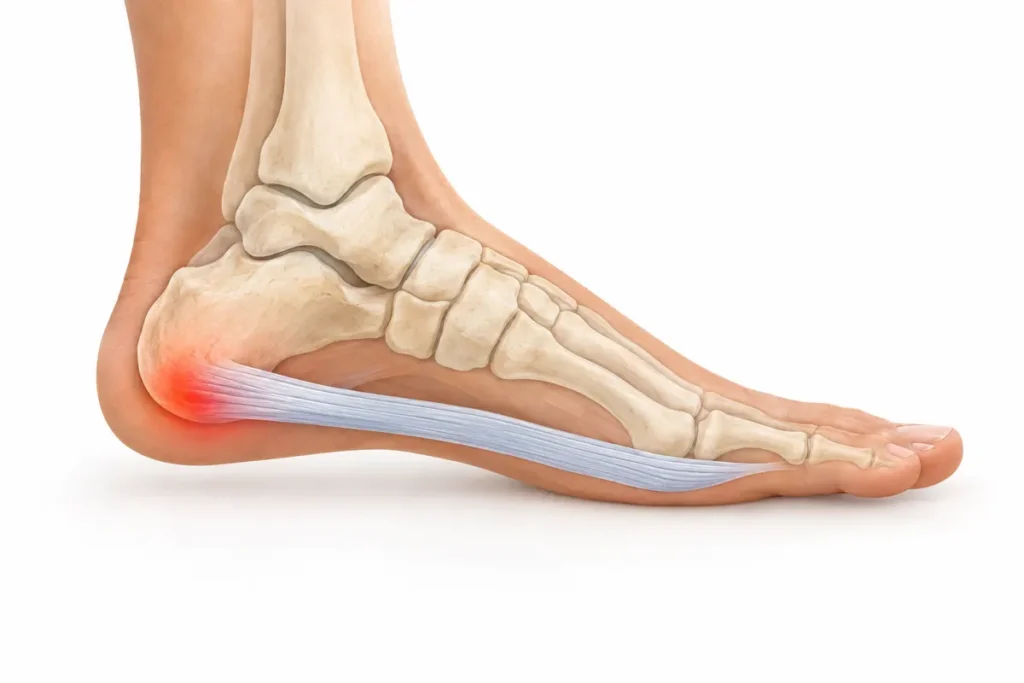
Running along the underside of your foot is a tough, fibrous band called the plantar fascia. It stretches from your heel bone to the base of your toes and acts a bit like a supportive cable for your arch.
Plantar fasciitis is the term used when this tissue becomes painful, most often close to where it joins the heel. You may also see it called plantar fasciopathy or plantar heel pain.
Although “itis” suggests inflammation, that does not tell the whole story. Ongoing heel pain is often related to the tissue becoming less able to cope with the demands placed on it. This is why treatment usually focuses on gradually improving how your foot handles load, rather than simply resting it.

Plantar fasciitis rarely starts with a single injury. It tends to creep up when your feet are asked to do more than they are used to.
Things that can play a part include:
Your foot shape is not necessarily to blame. Many people with flat feet or high arches never develop heel pain, so it is more helpful to look at your activity, footwear and routine as a whole.
Most people describe a similar pattern:
Because the pain often settles once you warm up, it is easy to keep going as normal — only for it to return later in the day or the next morning.
Other conditions, such as nerve irritation or a stress fracture, can cause pain in a similar area. A professional assessment helps make sure you are treating the right problem.
In most cases, yes.
You may need to ease off the activities that aggravate your heel for a while, but stopping completely is rarely necessary. Keeping active within comfortable limits helps protect your fitness and supports your recovery.
Helpful changes might include:
Think of it as finding a level of activity your heel can manage — and building up from there.
Your physiotherapist will start by getting to know your heel pain and how it is affecting your day-to-day life.
Your assessment may include:
Using this information, your physiotherapist will create a personalised treatment plan and adjust it as you progress. At PHT we are going to assess not only the foot but also go above and beyond into assessing the root cause for it by assessing the whole lower limb.
Scans are not usually needed if your symptoms and examination clearly suggest plantar fasciitis. They may be helpful if the diagnosis is unclear or if your symptoms are not improving as expected.
Treatment is tailored to you, as there is no single approach that suits everyone. A strong starting point often combines plantar fascia stretches, exercises, therapeutic ultrasound, short-term taping and practical advice about activity and footwear.
Adjusting Your Daily Activity
Your plan will take into account how much time you spend on your feet and what tends to trigger your pain. Simple, realistic changes — such as building in short breaks or adjusting your walking distance — can make a real difference.
Plantar Fascia Stretches
Gentle stretches targeting the sole of the foot can help reduce pain with your first steps. Your physiotherapist will show you how to do them correctly and how often.
Taping
Taping can provide short-term relief, particularly for morning pain. It is most useful alongside other treatments rather than on its own.
Footwear Advice
Comfortable shoes with good cushioning and a secure fit can make standing and walking easier. If you spend a lot of time barefoot at home, wearing supportive footwear indoors may help.
Strengthening
Foot and calf exercises may be included to build strength and help you return to your usual activities. Research into how much extra benefit strengthening adds is still ongoing, so it is usually one part of a wider plan.
Further Options
If your symptoms are slow to improve, your clinician may discuss additional treatments such as shockwave therapy or insoles (foot orthoses). These are not needed by everyone and will depend on your individual situation.

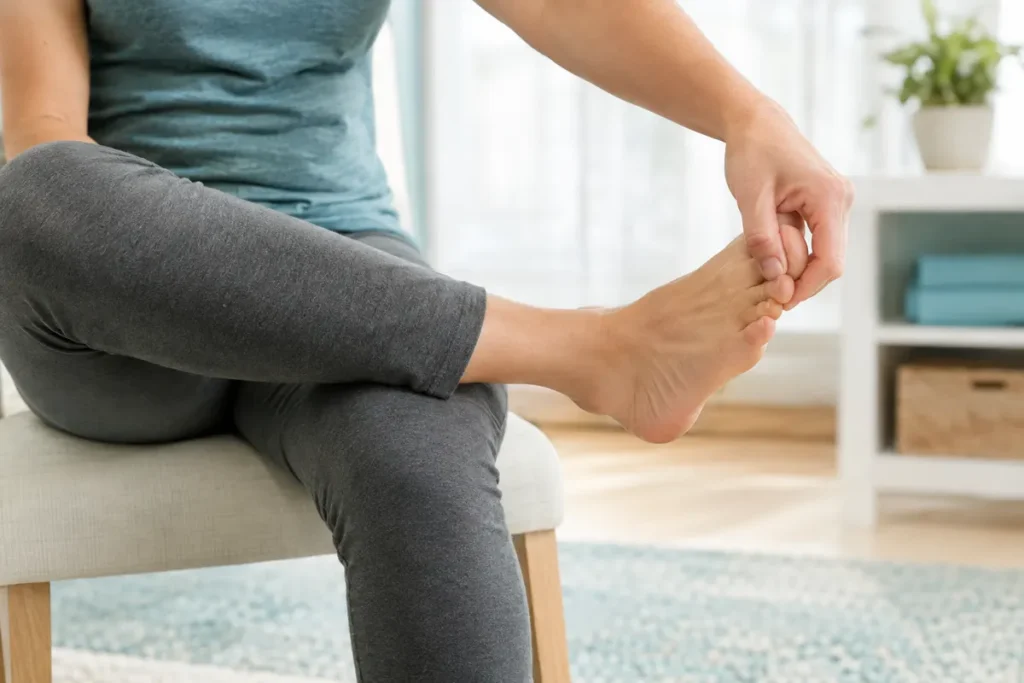
This simple stretch can be done while sitting:
It can be especially useful before getting out of bed or before standing up after a long period of sitting. Your physiotherapist can advise how long to hold it and how many times to repeat it. If the stretch causes sharp pain or leaves your symptoms worse for a long time afterwards, stop and seek advice.
Everyone recovers at a different pace.
Some people start to feel better within a few weeks, while others may have symptoms for several months. There is no set timeframe that fits everyone.
Your physiotherapist will usually review your progress after around four to six weeks to see how your plan is working and make changes if needed.
Signs you are heading in the right direction include:
Arrange an assessment if your heel pain:
If you have diabetes and notice foot pain, seek medical advice promptly.
Pain that often wakes you at night, or that does not behave in the usual activity-related way, should always be checked by a professional.
Living with heel pain can be draining, especially when it greets you every morning. You do not have to work it out on your own.
A physiotherapy assessment can help you understand what is causing your pain, make sensible changes and follow a plan that works around your life.
We and our partners, including Google, use cookies and personal data to analyse traffic and for ads personalisation and measurement. You can accept, reject or choose which cookies to allow. Privacy Policy • Cookie Policy • Terms & Conditions • Google Privacy
We use cookies to help you navigate efficiently and perform certain functions. You can choose which categories to allow below. Cookies categorised as Necessary are always active.
We also use third-party cookies for analytics and advertising. These are only stored with your consent. You can update or withdraw consent at any time via the cookie icon at the bottom-left. This site operates under UK GDPR, the Data Protection Act 2018, and the Privacy and Electronic Communications Regulations (PECR). Cookie Policy • Privacy Policy
Necessary cookies are required for core site features including security, network management, and consent storage.
| Cookie | Duration | Description |
|---|---|---|
hmdg_cookie_consent | 180 days | Stores your cookie consent preferences. |
PHPSESSID | Session | WordPress session identifier. |
wordpress_logged_in_* | Session | WordPress login authentication. |
Functional cookies enable enhanced features such as live chat and remembering preferences.
| Cookie | Duration | Description |
|---|---|---|
wp-settings-* | 1 year | Stores user interface preferences. |
Analytics cookies help us understand visitor behaviour. Controls analytics_storage for Google Analytics 4.
| Cookie | Duration | Description |
|---|---|---|
_ga | 2 years | Google Analytics — distinguishes users. |
_ga_* | 2 years | Google Analytics 4 — session persistence. |
_gid | 24 hours | Google Analytics — distinguishes users. |
_gat | 1 minute | Google Analytics — throttles request rate. |
Performance cookies collect aggregate, anonymous data about site performance.
| Cookie | Duration | Description |
|---|---|---|
_gat_gtag_* | 1 minute | Google Tag Manager — rate throttle. |
Marketing cookies track visits to deliver relevant ads. Controls ad_storage, ad_user_data, and ad_personalization.
| Cookie | Duration | Description |
|---|---|---|
_gcl_au | 90 days | Google Ads — conversion tracking. |
_gcl_aw | 90 days | Google Ads — click attribution. |
_gac_* | 90 days | Google Ads — campaign information. |
IDE | 1 year | Google DoubleClick — ad targeting. |
Powered by HMDG • Cookie Policy
